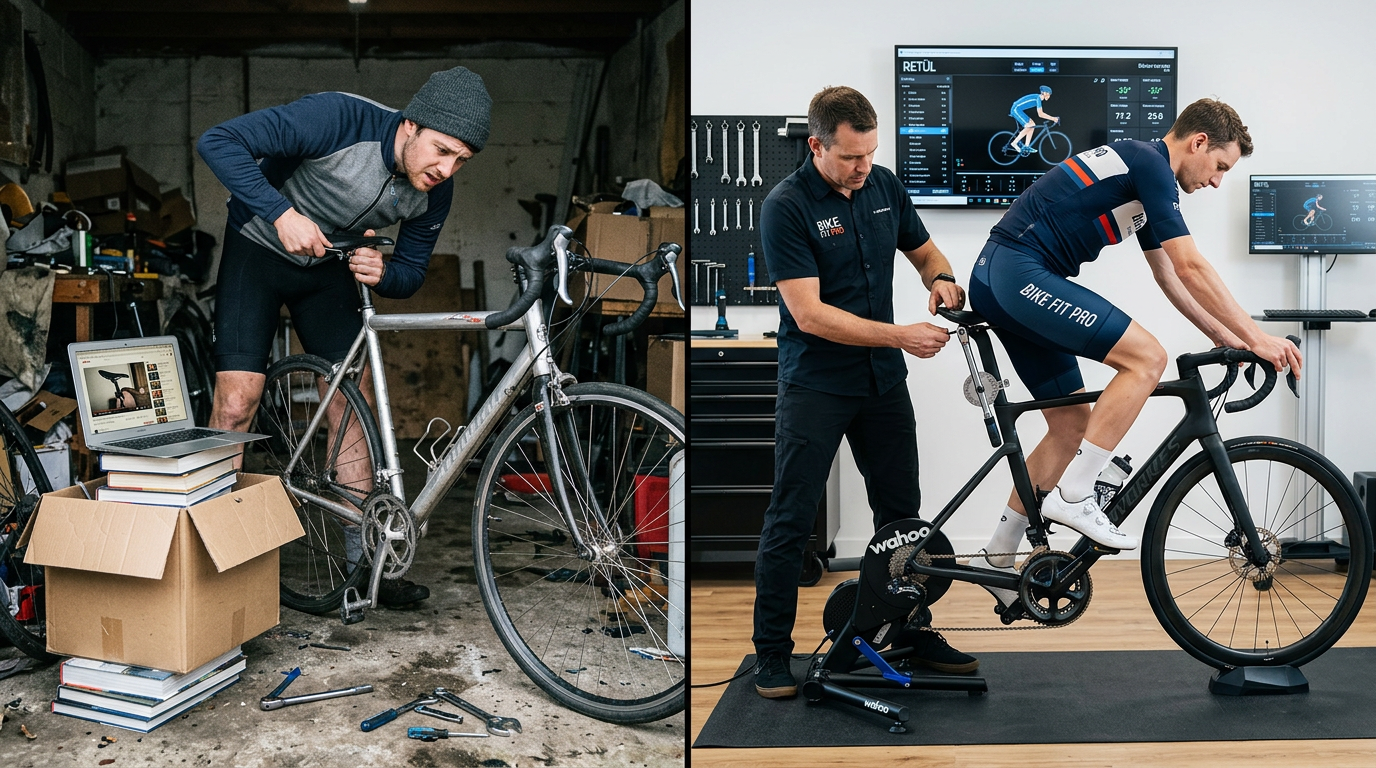
The YouTube Bike Fit Problem
Search “bike fit” on YouTube and you’ll find hundreds of videos promising to fix your position in 10 minutes. Some advice is solid. But there’s a fundamental limitation: you can’t see yourself ride.
Even if you film yourself, a video shows 2D movement on one axis. A professional fitter observes you in 3D, from multiple angles, while also considering flexibility, injury history, and riding goals.
What You CAN Do Yourself
These adjustments are safe for most riders to try:
Saddle Height (Heel Method)
Place your heel on the pedal at the bottom of the stroke. Your leg should be fully extended with no hip rocking. When you clip in normally, you’ll have a slight bend at the knee. This gets you within 90% of optimal.
Handlebar Angle
Road bike hoods should be angled so your wrists are in a neutral position, not bent up or down. Most people get this wrong by angling the hoods too far up.
Saddle Tilt
Start with the saddle level (use a spirit level app on your phone). If you experience perineal pressure, tilt the nose down 1-2 degrees. No more, because excessive tilt pushes you forward onto your hands.
What You SHOULDN’T Do Yourself
These adjustments require professional assessment:
Cleat Position
Cleat alignment affects your knee tracking through every single pedal stroke. A 2-3mm error, repeated thousands of times per ride, causes overuse injuries. A fitter uses tools and observation to align cleats with your natural foot angle and knee path.
Saddle Fore/Aft
The “knee over pedal spindle” (KOPS) rule from YouTube is a starting point, not a fit. Optimal fore/aft depends on your femur length, riding style, and flexibility. Getting this wrong shifts your weight distribution and affects both knee loading and power output.
Reach and Stack
Stem length, spacer height, and handlebar drop determine how your upper body is positioned. This requires assessing your hip flexibility, core strength, and intended riding style. A 10mm stem swap changes your entire weight distribution.
Compensatory Patterns
This is the biggest reason to see a professional. If your saddle is 5mm too high, your body compensates: your hips rock, your ankle over-extends, and your knee tracks inward. You won’t notice these compensations yourself. A fitter (especially one with motion capture) sees them immediately.
The Cost of Getting It Wrong
A DIY fit that’s 80% correct feels fine for the first 20 km. The remaining 20% shows up as:
- Gradual onset knee pain after 40-50 km rides
- Numb hands that worsen over months
- Lower back tightness that becomes chronic
A professional fit costs RM250-RM800. A physiotherapy session for a cycling overuse injury costs RM150-RM300 per visit, and you’ll need several.
The Verdict
Use YouTube to learn the basics and make rough adjustments. Then invest in a professional fit to dial in the details. The combination gives you the best outcome.