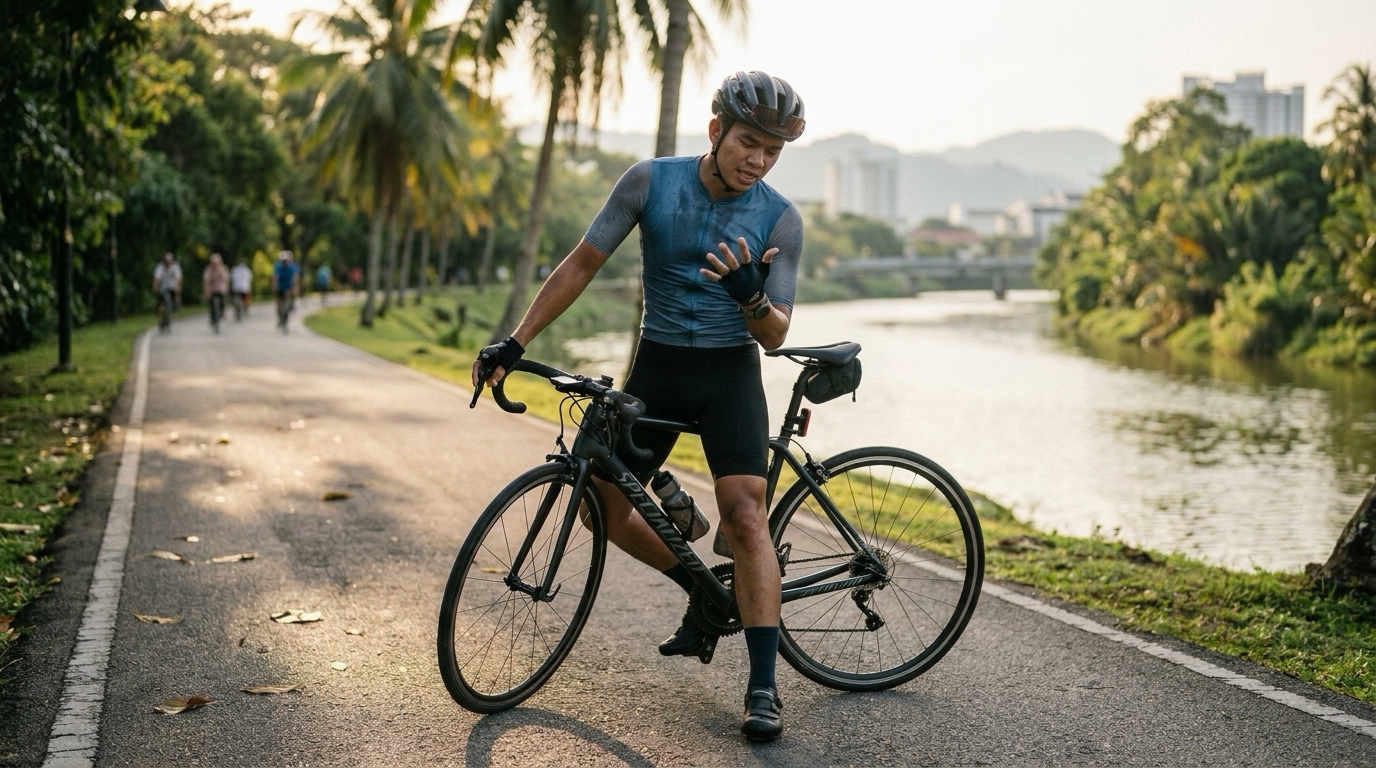
The Problem Almost Every Rider Recognises
You are 40km into a Sunday ride, somewhere out past Gopeng, and it starts. A tingle in the ring finger. A dull numbness spreading across the outside of the palm. You shake the hand out, change your grip, and it fades. Twenty minutes later it comes back.
If that sounds familiar, you are firmly in the majority. A survey of 3,300 amateur cyclists preparing for a one-day 94.7km event found that 41% reported hand or wrist symptoms. Of that group, 67% described pins and needles, 44% reported outright loss of sensation, and 13% had weakness in the hand.
That study matters more than the usual numbers you see quoted, because most cycling nerve research is done on multi-day tours and 600km ultra events. This one looked at amateur riders training for a single-day ride, which is a much closer match to a typical Malaysian weekend rider.
What Is Actually Being Compressed
The condition has a name: cyclist’s palsy, sometimes called handlebar palsy.
The ulnar nerve runs into your hand through a narrow passage at the base of the palm on the little-finger side, called Guyon’s canal. That spot is almost exactly where your hand presses into the bar. Sustained pressure there compresses the nerve, and you feel it in the ring and little fingers.
A narrative review of the cycling nerve literature puts the mechanism plainly: the trigger in most cases is pressure on the hands supporting the rider’s body weight, and the compression worsens when the wrist is extended or bent toward the little finger, which is the common position riders adopt on the bars.
A second, separate problem shows up in the thumb, index, and middle fingers. That is the median nerve, the same nerve involved in carpal tunnel syndrome. It is worth telling the two apart, because they point at different fixes.
Quick self-check: numbness in the ring and little fingers points to the ulnar nerve. Numbness in the thumb, index, and middle fingers points to the median nerve.
The Research on Pressure, Position, and Gloves
This is where the evidence gets genuinely useful, because someone actually measured it.
A study of 36 experienced cyclists rode them at constant power on a stationary bike while a high-resolution pressure mat recorded exactly how hard the palm was loading, with wrist angle tracked by motion capture. The findings:
- Peak pressure at the base of the palm reached 134 to 165 kPa with no gloves. The authors concluded these loads are high enough to damage the ulnar nerve if sustained for long periods.
- The drops produced the highest pressure and the most extended wrist posture. The tops were the gentlest position.
- Padded gloves cut peak pressure by 10 to 28%. Thin foam padding performed slightly better than gel.
Two practical conclusions fall out of that. First, gloves help, and thin foam beats thick gel, which is the opposite of what most riders assume when buying. Second, and more importantly, it is the combination of pressure and duration that does the damage. Moving your hands is not a comfort habit, it is how you reset the clock on the loading.
The Bike Fit Side
Here is where I want to be straight with you, because a lot of bike fit content overstates this.
There is no randomised trial showing that a professional bike fit cures hand numbness. The evidence for position changes is mechanistic: we know what generates pressure at Guyon’s canal, and we know which setup choices increase it. That reasoning is sound, and it is what a good fitter works from, but it is a different grade of evidence than the direct trial data we have for bike fit and knee pain.
With that caveat, the setup factors that increase hand loading are:
Too much saddle-to-bar drop. The bigger the drop from saddle to bars, the more of your upper body weight the hands carry. This is the single most common contributor.
Reach that is too long. Overreaching locks the elbows, stops the arms working as suspension, and drives weight into the palms. A frame that is nominally your size can still have the wrong reach for your torso and arm proportions.
Bar rotation and wrist angle. Since wrist extension is what narrows the nerve’s passage, bars rotated so your wrist sits cocked back are working directly against you. Neutral wrists, not bent up or down.
Bar width. Bars much wider than your shoulders push the wrists into an awkward angle. Matching bar width roughly to your shoulder joints keeps the forearm and wrist aligned.
A nose-down saddle. Tilt the saddle nose down and you slide forward continuously, catching yourself on your hands. Riders often do this to fix saddle discomfort and inherit a hand problem instead.
Worth noting: these interact. Raising the bars changes your reach. Changing reach changes your weight distribution and how the saddle loads. This is the reason piecemeal self-adjustment tends to move a problem around rather than solve it, which we covered in Professional Bike Fit vs YouTube DIY.
What to Try Before Booking Anything
Genuinely free things, in order of impact:
- Change hand position every 10 to 15 minutes. Tops, hoods, drops on a road bike, or bar ends on a flat bar. Set a habit before the numbness starts, not after.
- Get thin foam padded gloves. Measured 10 to 28% pressure reduction, and cheap.
- Raise your bars. If you have spacers under the stem, move one above it, or flip the stem. Even 1cm shifts weight rearward.
- Level your saddle. Check it with a spirit level on a flat floor. Nose-down is a common hidden cause.
- Unlock your elbows. Locked-out arms transmit every road buzz straight into the nerve. Soft elbows are free suspension.
If the numbness still returns after a few rides of doing all five, the cause is in your position, and that is worth measuring properly.
When It Stops Being Just Annoying
In the amateur survey, 85% of riders with hand symptoms had them resolve within an hour of finishing the ride. That is the normal pattern. Transient numbness that clears shortly after you get off the bike is common and not alarming.
Take it seriously if:
- Numbness persists for hours or days after riding
- You have weakness or clumsiness in the hand, dropping things or struggling with keys and zips
- Symptoms are clearly worse in one hand than the other, which points at an asymmetry in your position or an underlying issue
The reason to act rather than ride through it: an electrophysiological study tested 14 riders before and after a 6-day, 420-mile tour and found measurable slowing in the deep branch of the ulnar nerve afterwards. Three hands showed worsening carpal tunnel findings, and one rider developed them from scratch over the event. These are real physiological changes, not just discomfort. Persistent symptoms warrant a doctor, not just a fitter.
The Honest Summary
Hand numbness is a pressure problem. Your palm is carrying load it was not designed to carry for hours at a time, over a nerve that sits in a bad spot for the job. Gloves and moving your hands reduce it. Position determines how much load lands there in the first place.
Most riders can improve this substantially on their own with the five steps above. If it keeps coming back, a fit that measures your actual weight distribution rather than guessing is the sensible next step. And if the numbness outlasts the ride by hours, see a doctor first and a fitter second.
For an overview of the other common cycling complaints and what causes them, see our guide to cycling pain.
References
- van der Walt, A., Janse van Rensburg, D. C., Fletcher, L., Grant, C. C., & van der Walt, A. J. (2014). Non-traumatic injury profile of amateur cyclists. South African Journal of Sports Medicine, 26(4), 119-122. DOI: 10.7196/SAJSM.555. The 3,300-rider amateur survey.
- Slane, J., Timmerman, M., Ploeg, H. L., & Thelen, D. G. (2011). The influence of glove and hand position on pressure over the ulnar nerve during cycling. Clinical Biomechanics, 26(6), 642-648. PubMed: 21458120. The pressure and glove measurements.
- Sirisena, D. C., Sim, S. H. S., Lim, I., & Rajaratnam, V. (2021). Median and ulnar nerve injuries in cyclists: A narrative review. Biomedicine (Taipei), 11(4), 1-12. PMC8823486. Mechanism and risk factors.
- Akuthota, V., Plastaras, C., Lindberg, K., Tobey, J., Press, J., & Garvan, C. (2005). The effect of long-distance bicycling on ulnar and median nerves: an electrophysiologic evaluation of cyclist palsy. American Journal of Sports Medicine, 33(8), 1224-1230. PubMed: 16000656. Nerve conduction changes after a 6-day tour.
- Patterson, J. M. M., Jaggars, M. M., & Boyer, M. I. (2003). Ulnar and median nerve palsy in long-distance cyclists: A prospective study. American Journal of Sports Medicine, 31(4), 585-589. DOI: 10.1177/03635465030310041801. 23 of 25 riders symptomatic after 600km.
Ready to Sort It Out Properly?
If you have worked through the quick fixes and your hands still go numb, the problem is how your weight is distributed across the bike. Chat with our AI bike fit expert on WhatsApp for a free assessment. Tell us where the numbness is, when it starts, and what you have already tried, and we will point you at the likely cause.