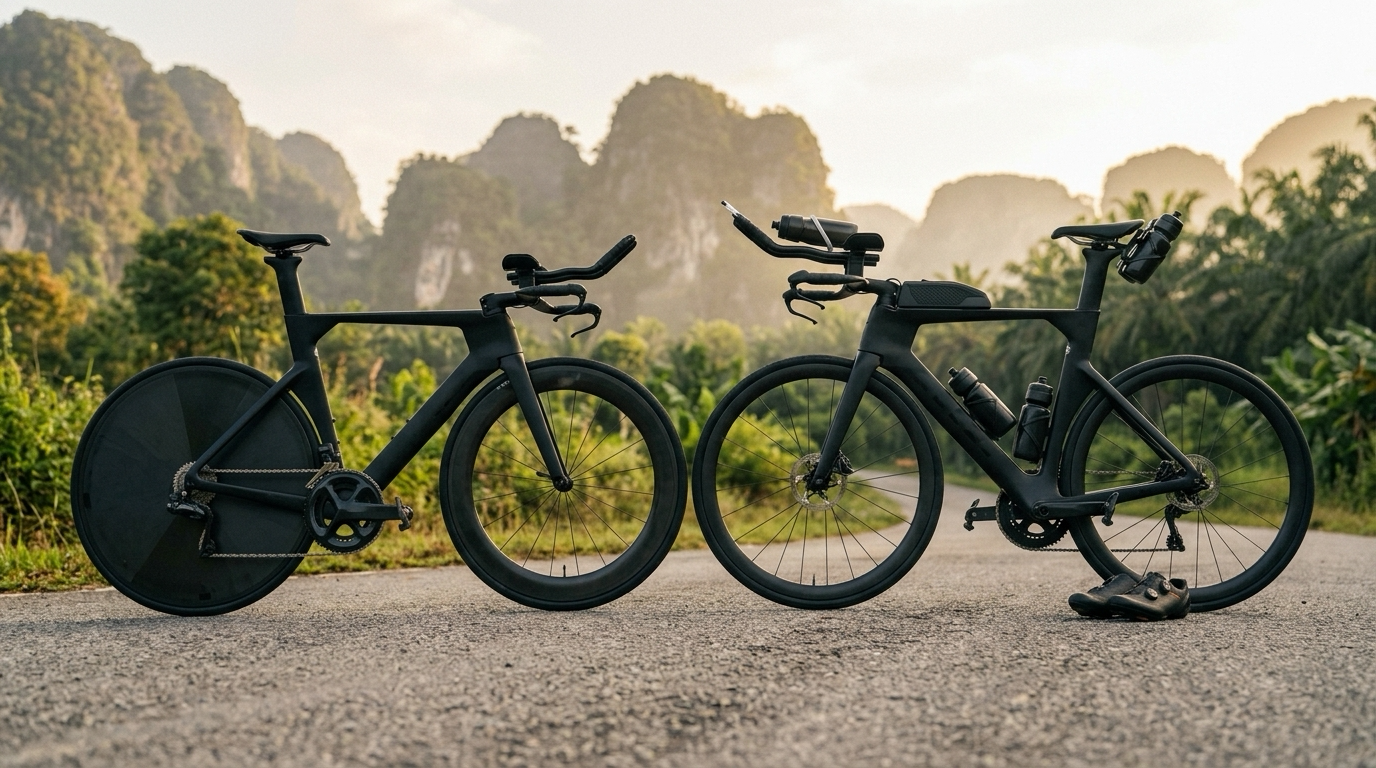
The Bike Everyone Is Calling a “TT”
Duathlons and triathlons have pulled a lot of Malaysian road cyclists into multisport over the last couple of years, and with them came a wave of new aero bikes. Most of their owners call them TT bikes.
Many of them are not. Or more precisely, many of them are being ridden in triathlon and duathlon, which is a different job from the one a time trial bike was designed for. When a rider tells us their “TT” position feels great for half an hour and then falls apart, the confusion between the two is usually part of the story.
From the side, a time trial bike and a triathlon bike look almost identical: deep tubes, a low front end, and a pair of extensions sticking out in front with pads for your forearms. The difference is in what each bike is asked to do, and that changes how it should be set up on you.
Two Different Jobs
A time trial is short and hard. A road time trial typically lasts somewhere between 20 minutes and an hour, ridden close to your limit the whole way, in zone 4 and 5. Nobody needs to carry food. Nobody needs to get off and run. The only goal is to cover the distance as fast as possible, so the position is pushed as far towards aerodynamics as the rider can tolerate for that short window.
A triathlon or duathlon bike leg is long, and it is not the end of your race. An Olympic-distance bike leg is 40 km, a 70.3 is 90 km and a full distance is 180 km. You ride it after swimming or running, and you have to run again afterwards. The position has to be one you can hold for hours, eat and drink in, and climb off with legs that still work.
Our fitter’s comparison is the clearest one we have heard: it is like the difference between an endurance road bike and an aero race bike. The same gap exists here, and because both bikes are so specialised, every difference between them is magnified.
The Rulebook Shapes the TT Bike
Time trial bikes are designed around the UCI’s technical regulations, because that is what they are raced under. Three rules matter most for fit:
- The saddle tip must sit at least 50mm behind the bottom bracket. A rider can apply for an exemption to bring it forward, but never past the vertical line through the bottom bracket.
- The extensions can reach at most 750mm in front of the bottom bracket. Taller riders can apply for 800, 830 or 850mm depending on their height category, but a rider can use only one exemption: the forward saddle or the longer extensions, not both.
- The bike must weigh at least 6.8 kg.
That saddle rule is the important one. It limits how far forward a TT rider can rotate on the bike, which is why TT frames have relatively conventional seat angles and why the rider gets low by dropping the front instead.
Non-drafting triathlon is not bound by those position rules. That is the format most age-group triathletes race, and it is what allowed triathlon bikes to evolve differently: steeper effective seat angles so the rider can sit further forward over the cranks, saddles designed to be sat on the nose, and frames with storage built in. Our fitter points out that a TT bike usually has no cargo system at all, because it never needs one, while a tri bike carries hydration, nutrition and spares as part of the frame.
There is one catch worth knowing before you buy. Some events, including age-group draft-legal races under World Triathlon rules, do not allow clip-on aero bars at all. Check the rules of the events you actually plan to race.
Why the Fit Is Different
The trade-off in any aero position is the same: the lower your torso, the less drag you create, and the harder it becomes to produce power.
Researchers at the University of Birmingham measured this directly. Nineteen well-trained cyclists did incremental tests at five torso angles, from their preferred position down to completely flat. Every maximal value they measured dropped as the torso got lower, including peak power output, and at fixed submaximal intensities the physiological cost went up as the torso went down. The completely flat 0° position hurt the riders significantly more than any of the others.
A second study from the same group used that data to model the optimal position against speed. Aerodynamic losses only outweighed the power losses above 46 km/h. A fully horizontal torso was never optimal, and below 30 km/h a more upright position was better.
That is the core of the TT versus tri difference. A time trialist riding for 30 minutes at very high speed has every reason to accept a lower, more aggressive torso. A triathlete riding 90 km at a slower pace, in a position they also have to eat in, gets less back from the aero gains and pays the physiological cost for much longer.
The Run Off the Bike
The steep seat angle on a triathlon bike is not just about comfort. There is evidence it helps the run that follows.
In a study of eight male triathletes, each rode 40 km at a 73° seat tube angle and again at 81°, at the same intensity, then immediately ran a self-paced 10 km on a treadmill. After the steeper 81° ride:
- The 10 km run was faster: 42:55 against 46:15 on average.
- The combined bike and run time was faster: 1:45:49 against 1:50:33.
- Most of the gain came in the first 5 km of the run (21:41 against 24:15), and it had largely disappeared by the second 5 km.
The usual caveats apply. Eight riders is a small group, it was a lab study at a fixed cycling intensity rather than a real race, and nobody has repeated the result at scale. But it is consistent with what triathletes have reported for years: a position that rotates you forward over the cranks leaves your legs in better shape for the run.
A time trialist never has to run, so their bike is never designed around this.
Can You Set Up a TT Bike for Triathlon?
You can, and plenty of people do, especially since many modern frames are sold as UCI-legal for both. The limitation is the front end. A frame designed for a time trial position usually has a low stack, and when you build it into a more relaxed triathlon position, the base bar ends up too low to feel comfortable. Riders end up stacking spacers and risers on the extensions while the base bar stays where it was.
The reverse problem is just as common. A rider takes an aggressive TT-style position into a long triathlon because it looks fast, and spends the second half of the bike leg sitting up, shifting around on the saddle, and arriving at transition with a sore neck and a tight lower back.
Holding a low aero position for 100 km also asks a lot of your core. If your trunk cannot support the position, your weight drops onto your forearms and shoulders, and the position collapses long before the finish.
Moving Your Fit to a New Bike
The most common story we hear goes like this. A rider is comfortable on their old triathlon bike for years, buys a new one from a different brand, copies the numbers across, and the new bike never feels right.
Copying a fit between two aero bikes is harder than it looks. Different frames use different stack, reach and seat angle, extensions and armrest pads come in different widths and shapes, and the saddle-to-pad relationship rarely transfers cleanly. Small differences in armrest pad width or a saddle sitting slightly too far forward are enough to turn a comfortable position into a painful one. And when the shop building the new bike does not follow the old fit report closely, the rider concludes the old bike was simply better.
If you have not been fitted in years and you have just changed bikes, assume the old numbers are a starting point, not an answer.
Which One Do You Actually Have?
Before you change anything on your bike, answer these questions:
- What events do you race? Short time trials, triathlon, duathlon, or all three? And are any of them draft-legal, where aero bars may not be allowed?
- How long is your bike leg? Twenty minutes and three hours need different positions.
- Do you run afterwards? If yes, the run is part of the fit.
- Where does it hurt, and when? Pain that arrives after 45 minutes points to a position you can hold for a time trial but not for a triathlon.
- What was your last fit done on? If it was a different bike, it may not have transferred.
References
- UCI (2025). Clarification Guide of the UCI Technical Regulation, version applicable from 1 February 2025. PDF. Article 1.3.013 on the 50mm saddle setback, the 750mm default extension limit and the 800/830/850mm height categories, the single-exemption rule, and the 6.8 kg minimum weight.
- Triathlon Magazine Canada (2026). The Competition Rules Every Triathlete Should Know Heading Into the 2026 Season. Link. Non-drafting triathlon not governed by UCI frame and position rules, and clip-on aero bars prohibited in age-group draft-legal racing.
- Fintelman, D. M., Sterling, M., Hemida, H., & Li, F. X. (2015). The effect of time trial cycling position on physiological and aerodynamic variables. Journal of Sports Sciences, 33(16), 1730-1737. PubMed: 25658151. Nineteen cyclists at five torso angles; maximal values fell and physiological cost rose as the torso was lowered.
- Fintelman, D. M., Sterling, M., Hemida, H., & Li, F. X. (2014). Optimal cycling time trial position models: aerodynamics versus power output and metabolic energy. Journal of Biomechanics, 47(8), 1894-1898. PubMed: 24726654. Aerodynamic losses outweigh power losses above 46 km/h; a more upright position is better below 30 km/h.
- Garside, I., & Doran, D. A. (2000). Effects of bicycle frame ergonomics on triathlon 10-km running performance. Journal of Sports Sciences, 18(10), 825-833. PubMed: 11055818. The 73° versus 81° seat tube angle study and the run times.
Riding a TT or Tri Bike? Tell Us Before Your Fit
An aero bike fit needs different equipment from a road fit, so let us know when you book that you are bringing a TT or triathlon bike, and what events you race. Every fit is one package at RM650, including 3D motion capture plus foot and sit bone pressure mapping, which is exactly what you want when the question is how long you can hold a position.
Chat with our AI bike fit expert on WhatsApp for a free assessment. Tell us your bike, your events, and when in the ride the discomfort starts.